برچسب: PalCast

  • New PalCast Episode: Creativity comes from Misery – Roaa’s Story

    New PalCast Episode: Creativity comes from Misery – Roaa’s Story

    [ad_1]

    PalCast released a new episode titled “Creativity Comes from Misery – Roaa’s Story,” featuring Roaa Aladdin Missmeh, a Palestinian from Gaza now pursuing her master’s degree in Linguistics and Applied Linguistics in Dublin. The episode, hosted by Yousef and Tony, shared Roaa’s personal journey from the heart of Gaza during the genocide to her new life in Ireland. It shed light on her story of loss, displacement, and survival, as well as how writing became her way of holding on to hope and her identity.

    Roaa spoke about the repeated displacements her family faced, which included fleeing their home more than a dozen times, moving between relatives’ houses, friends’ homes, and tents on the streets. She described the unbearable living conditions in the camps: cold winters, lack of clean water, and the struggle to cook meals with makeshift stoves. Despite the hardship, she said that creativity emerged from misery, and writing became her escape. It was through words that she documented her pain, her people’s resilience, and her will to remember.

    She also revealed how the so-called “safe zone” of Al-Mawasi was anything but safe, as Israeli attacks continued to target civilians daily. Her memories of Gaza, filled with fear and destruction, remained vivid even after she left. Living in Dublin, she mentioned feeling constant guilt for surviving while many of her loved ones were killed. For Roaa, true survival meant rebuilding her home, bringing back her dead friends, and seeing her family safe again, which were things she knew might never happen.

    This episode of PalCast highlighted the deep emotional scars carried by survivors and the strength found in storytelling. Roaa’s testimony served as a reminder that leaving Gaza did not mean Gaza left her. Her story was one of endurance, grief, and the power of the written word. The episode is now available to listen to on Apple Podcasts and Spotify.


    [ad_2]

    Source link

  • New PalCast Episode: ‘When Words Are All That Remain’

    New PalCast Episode: ‘When Words Are All That Remain’

    [ad_1]

    The new episode of PalCast, titled “When Words Are All That Remain,” featured Ruba Khalid Al-Faleet, a Palestinian writer, artist, and poet from Gaza. Known for her work with the Gaza Poets Society and the Resilient Voices storytelling project, Ruba spoke about life under siege and how art became her way to survive and resist. Her poetry and paintings reflected the endurance of a people determined to hold on to identity, memory, and hope, even when everything else was taken away.

    Tony led the conversation as Ruba joined from Gaza to share her story of loss and perseverance. She described how the ongoing genocide and ethnic cleansing devastated families, including her own, and how writing became a form of healing and protest. The episode carried a deep sense of grief, especially as PalCast host Yousef was unable to join after losing nine close family members in an Israeli airstrike on their home in Nuseirat Camp. A second strike later targeted those helping bury them, killing four more. The PalCast team extended their condolences and solidarity to Yousef and his family.

    Throughout the episode, Ruba spoke about the harsh realities of displacement and daily survival. She described families forced to live in tents, cook over open fires, and struggle to afford even basic food. Her words revealed the deep frustration many Palestinians felt toward global leaders who made decisions about Gaza from afar, detached from the suffering on the ground. She called for Palestinians to reclaim their narrative and demand that their voices shape their own future.

    Ruba also shared how writing became her lifeline. In the quiet of her small room, she wrote letters to an imagined friend, bearing witness to her people’s pain and strength. Her dream to study linguistics and use her art to advocate for Palestinian rights stood as a reminder that creativity can outlive destruction. The new episode of PalCast is now available to stream on Apple Podcasts and Spotify.


    [ad_2]

    Source link
  • New PalCast Episode: Drone Strikes on the Flotilla as Gaza City is Destroyed

    New PalCast Episode: Drone Strikes on the Flotilla as Gaza City is Destroyed

    [ad_1]

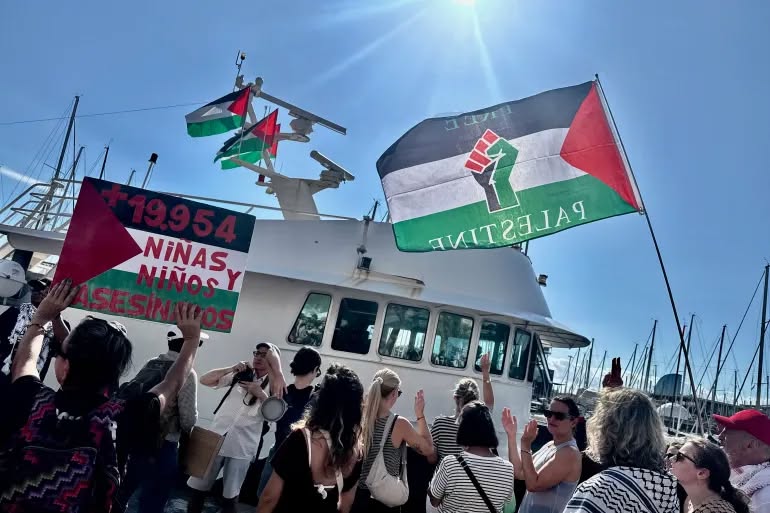
    The latest episode of PalCast featured Sinn Féin Senator Chris Andrews, who joined from the Sumud Flotilla as it came under repeated attack by Israeli drones. His ship was struck four times during the night, yet he and more than twenty Irish participants on board stayed committed to their mission of delivering aid to Gaza. Despite the dangers, Andrews reported that the flotilla remained determined to highlight the ongoing siege and the refusal of governments to act.

    During the episode, Yousef and Tony spoke with Andrews about the political message behind the flotilla and the lack of meaningful support from states like Ireland. Andrews condemned the Irish government’s reliance on empty statements while failing to protect its own citizens or challenge Israel’s violations of international law. He contrasted this silence with Italy’s decision to send a naval frigate to protect its participants. For him, the flotilla carried out the work that governments should have done long ago: bringing aid and breaking the silence around Gaza’s suffering.

    The conversation also covered the dire situation in Gaza City, where relentless bombing continued to displace thousands of people. Andrews described what was happening as genocide and a man-made famine, warning that if Israel continued unchecked, similar crimes would spread to the West Bank and beyond. A recorded message from another participant on the flotilla revealed the fear and disbelief of being bombed in international waters, alongside frustration with Western governments and media for ignoring the attacks.

    PalCast released this episode to give voice to those risking their lives to bring aid and solidarity to Palestinians under siege. Listeners heard both the human cost of Gaza’s destruction and the determination of activists who refused to let governments and media bury the story. The new episode is now available to stream on Apple Podcasts and Spotify.

    [ad_2]

    Source link

  • New PalCast Episode: Chasing My Dream in a Genocide

    New PalCast Episode: Chasing My Dream in a Genocide

    [ad_1]

    PalCast released a new episode titled Chasing My Dream in a Genocide, featuring 19-year-old writer and activist Ahmad Abushawish from Gaza. Ahmad had already shared his voice through platforms such as Al Jazeera, Washington Report on Middle East Affairs, Electronic Intifada, Prism Reports, and We Are Not Numbers. In this episode, he spoke from Nuseirat, Gaza, only hours after finishing his final high school exams, offering a moving account of determination in the face of unimaginable hardship.

    Hosted by Yousef and Tony, the episode highlighted Ahmad’s struggle to complete his Tawjihi exams during Israel’s ongoing genocide against Gaza. He described how life froze under constant bombardment and how he used the metaphor of an escalator moving the wrong way to explain his daily struggle. Despite being displaced, losing close friends, and enduring crowded living conditions, Ahmad showed resilience and an unshaken will to keep moving forward.

    The conversation also shed light on Ahmad’s ambitions. He shared his dream of studying at a prestigious university abroad, not to escape Gaza, but to gain the skills needed to better serve his people. He expressed his wish to apply to UK universities to study engineering, while also recounting his writing journey and his efforts to support his community through small initiatives such as producing mosquito repellent for families in tents. His testimony painted a clear picture of how young Palestinians continued to resist despair through creativity and purpose.

    The hosts closed the episode by underscoring Ahmad’s strength and by reminding listeners that the United Nations had declared Israel’s actions in Gaza a genocide. They invited listeners to help Ahmad reach his dream of higher education and to stand with young Palestinians like him who refused to give up on their future. The episode is now available on Apple Podcasts and Spotify.


    [ad_2]

    Source link

  • New PalCast Episode: Journalism Is Not A Crime – Al Jazeera Correspondent, Hani Mahmoud

    New PalCast Episode: Journalism Is Not A Crime – Al Jazeera Correspondent, Hani Mahmoud

    [ad_1]

    PalCast released a new episode titled Journalism Is Not a Crime – Al Jazeera Correspondent, Hani Mahmoud. The conversation featured Hani Mahmoud, who left academia nearly two years ago to dedicate his life to reporting from Gaza. As Al Jazeera English’s correspondent in Gaza City, he became one of the most vital voices documenting Palestinian life under siege. His work carried the stories of Gaza’s people to the world, ensuring they were neither silenced nor distorted.

    In this episode, hosts Yousef and Tony interviewed Hani about his journey into journalism and the realities of reporting under bombardment. He described the challenges of covering the humanitarian catastrophe in Gaza and stressed the importance of Palestinians telling their own stories. For Hani, the unfiltered truth of life in Gaza was powerful enough without needing embellishment, and he insisted that controlling the Palestinian narrative remained central to resisting misrepresentation.

    Hani also spoke about the constant dangers faced by journalists in Gaza. He explained the risks of aerial surveillance, targeted attacks, and the heavy psychological burden of protecting his family while reporting. He described Israel’s evacuation orders as a tactic of ethnic cleansing, carried out under relentless bombing that left civilians with a 50/50 chance of survival whether they stayed or fled. His testimony revealed the depth of displacement and destruction Palestinians endured without the guarantee of safety.

    The episode further highlighted the daily struggles of life under siege, from the scarcity of basic goods to the irreversible damage of malnutrition among children. Hani contrasted the global outrage over the killing of privileged figures with the silence surrounding murdered Palestinian journalists, underscoring the world’s double standards. Through his voice, listeners heard not only the story of a journalist but the story of a people surviving against all odds. The episode is now available on Apple and Spotify.

    [ad_2]

    Source link

  • New PalCast Episode: Gaza City under siege – Nour’s Story

    New PalCast Episode: Gaza City under siege – Nour’s Story

    [ad_1]

    The latest episode of PalCast featured Gaza writer, journalist, and translator Nour Abo Aisha, who spoke from Gaza City as it remained under siege. Nour described how her writing had always centred on memory, displacement, and survival, drawn both from her own life and from the stories of those around her. She explained that for her, writing had been a form of resistance against erasure, a way to break through the silence forced on Palestinians. Her work had already appeared in publications such as The Guardian, Prism Reports, Mondoweiss, and Al Jazeera Net, and she was also a member of We Are Not Numbers.

    In this episode, hosted by Yousef and Tony, Nour shared her firsthand account of what it meant to live under siege. She described the catastrophic situation in her neighbourhood of Shaikh Radwan in western Gaza City, where most of her neighbours had fled to the south. Her family, however, refused to leave, holding on to their land despite Israel’s evacuation orders. Nour recalled the chilling atmosphere created by constant airstrikes, the sounds of bombing, and the deep uncertainty over what the next day would bring.

    Nour explained how Israel used psychological warfare to force people southward, from dropping leaflets and incendiary bombs to using loudspeakers that promised food and tents. She stressed that there was no safe place in Gaza, noting that her relatives who evacuated had also been killed. Before October 2023, Nour had been a university student studying English literature and working as a translator and content writer. Since then, her studies and work had been cut short, her social life erased, and she endured the loss of both friends and family, including her cousin and her aunt.

    Nour’s account revealed how her daily life had become centred on survival—finding water, carrying it upstairs, and worrying about food. She recalled earlier traumas, including surviving an airstrike in 2020 that killed her students while she volunteered as a teacher. She admitted her desire to leave Gaza, believing she could no longer endure the conditions, yet she felt compelled to share her story despite the pain. This powerful conversation is now available on Apple Podcasts and Spotify, offering listeners a raw and unfiltered glimpse into the realities of life under siege in Gaza.

    [ad_2]

    Source link

  • New PalCast Episode: The Global Sumud Flotilla

    New PalCast Episode: The Global Sumud Flotilla

    [ad_1]

    The latest episode of PalCast focused on the Global Sumud Flotilla, the largest coordinated attempt to break Israel’s near 20-year siege on Gaza. Hosts Yousef and Tony spoke with Lynn Boylan, an Irish Member of the European Parliament for Dublin and Chair of the EU’s Relationship with Palestine Committee. Boylan joined a Legal Monitoring ship setting sail from Italy to accompany the flotilla, which aimed to deliver aid to Palestinians enduring genocide and a manmade famine.

    The discussion highlighted the unprecedented scope of this initiative, with more countries and boats involved than in any previous flotilla. According to Boylan, despair, frustration, and heartbreak over the mass killing and starvation in Gaza had driven ordinary citizens, international law experts, and academics to act where politicians had failed. While monitoring boats did not carry aid, they prepared to document Israeli violations of international law and anticipated possible interception attempts.

    Boylan also spoke about the wider political implications. She noted that while some governments, including Spain and Ireland, showed signs of support, others sought to obstruct the mission, such as by blocking ships from departing certain ports. She expected diplomatic pressure and direct threats from Israel, stressing that her political role would be used to bring any evidence of Israeli aggression back to the European Parliament. She emphasized that the EU’s double standards on Palestine, compared to situations like Ukraine, had eroded its credibility and exposed its complicity.

    The episode underscored how the failure of governments and institutions forced individuals and grassroots groups to take responsibility for delivering aid and challenging the blockade. What should have been a duty of states had become the burden of civil society. The conversation captured both the hope and the urgency behind the Global Sumud Flotilla and its mission to confront the siege of Gaza. The episode is now available on Apple and Spotify.


    [ad_2]

    Source link

  • New PalCast Episode: My Unseen Memories

    New PalCast Episode: My Unseen Memories

    [ad_1]

    PalCast released a new episode titled “My Unseen Memories” featuring 22-year-old Imad Qudaih, a visually impaired student of English translation at the Islamic University of Gaza and a freelance journalist with BBC News since June 2024. Speaking from displacement in Al-Mawasi, Imad shared the destruction of his home village, the loss of his cat to an Israeli sniper, and the struggle of living under constant attacks. His story captured both the intimate and collective pain of life in Gaza today.

    During the conversation with Yousef and Tony, Imad described the repeated displacements his family endured, moving more than ten times in search of safety that never existed. He spoke of airstrikes that killed children collecting water and the murder of journalist Iman Ahmad by an Israeli drone while she tried to access basic needs. For Imad, even simple tasks became overwhelming. His visual disability made every new environment difficult to navigate, erasing the sense of familiarity he once had in his destroyed home.

    Imad also mourned the loss of his study tools, including his Braille machine, books, and laptop, buried under the rubble. Yet, despite injuries and personal losses, he continued his studies online and reported as a journalist, risking his life to make the voices of Gaza heard. He told stories of starvation, such as an old man begging for bread after five days without food, and he shared the grief of losing friends and cousins to Israeli bombings. For Imad, documenting these realities was not just work but a humanitarian duty.

    The episode revealed Imad’s fears for Gaza’s future and his belief that a plan existed to empty the territory of its people. He pointed to the destruction of entire towns and the starvation imposed on the population, warning that the suffering had reached levels no human being should endure. His call was clear: the war must end, and the world must act. “My Unseen Memories” is now available on Apple Podcasts and Spotify.


    [ad_2]

    Source link

  • New PalCast Episode: The Final Evacuation

    New PalCast Episode: The Final Evacuation

    [ad_1]

    The latest episode of PalCast, titled “The Final Evacuation,” featured the powerful voice of Sara Awad, a writer and English literature student from Gaza City. Sara, known for her contributions to outlets such as The Intercept, Truthout, and The Electronic Intifada, spoke from the heart of Gaza about the struggles her community endured. She shared her story of survival, the weight of evacuation orders, and the deep scars left by war.

    During the conversation, Sara described how her neighborhood received an evacuation order only an hour before the recording began. She explained how families were torn between staying in their homes despite the risk or leaving everything behind in search of safety. For many, the decision carried heavy financial and emotional costs, with transportation alone costing thousands of dollars. Sara’s own family chose to evacuate, highlighting the impossible choices faced by ordinary people living under siege.

    She also spoke about the devastation of the Nasser Hospital bombing, the destruction of Gaza’s universities, and the targeting of journalists. Sara described how her family sheltered relatives, endured hunger, and hid in basements during attacks. Despite these hardships, she emphasized the resilience of Gazans, their love for education, and their refusal to be silenced. She used her writing to document pain, resilience, and hope, reminding listeners that Palestinians are people with dreams and families, not statistics.

    This episode of PalCast offered an unfiltered glimpse into life in Gaza during one of its darkest times. Sara’s testimony stood as both a record of suffering and a call for solidarity. “The Final Evacuation” is now available to listen on Apple Podcasts and Spotify.


    [ad_2]

    Source link

  • New PalCast Episode: Gaza, When The War Ends

    New PalCast Episode: Gaza, When The War Ends

    [ad_1]

    PalCast released a new episode titled Gaza, When The War Ends.” Yousef and Tony spoke with poet and writer Nadera Mushtaha, a former student of the late Dr. Refaat Alareer. Nadera shared how she lost her family home in Shujayia and spoke about her friend, Malak Arafat, whose killing she only discovered seven months later because of the rolling internet blackouts in Gaza. Her voice carried the weight of both grief and resistance as the sounds of Israeli drones and tank shells echoed in the background.

    The discussion highlighted the ongoing bombardment of Gaza City, where neighborhoods such as Sabra and Zaytoun faced heavy shelling and threats of mass expulsion. Listeners heard about the catastrophic conditions for the 800,000 residents forced into displacement, with many pushed further south into areas already starved of aid. Nadera described the hunger that defined daily life, with families surviving on little more than water, and explained how aid shortages, inflated costs, and unsafe airdrops made survival even harder.

    She also spoke about the psychological toll of living under constant surveillance. The drones, which hovered day and night, created a suffocating atmosphere of fear and exhaustion. Their noise became a form of psychological warfare, depriving people of sleep and peace of mind. Despite the destruction, displacement, and loss, Nadera explained how writing remained her way to resist, telling human stories rather than letting them be reduced to statistics.

    The episode captured both the cruelty of the ongoing genocide and the resilience of those living through it. Nadera’s memories of Dr. Refaat, who urged his students to keep writing, served as a reminder of the power of words in the darkest times. “Gaza, When The War Ends” is now available to listen on Apple Podcasts and Spotify.

    [ad_2]

    Source link